It varies by who is looking
The same burn assessed by two clinicians, or on a different shift, does not reliably give the same percentage.
Stop estimating. Start measuring.
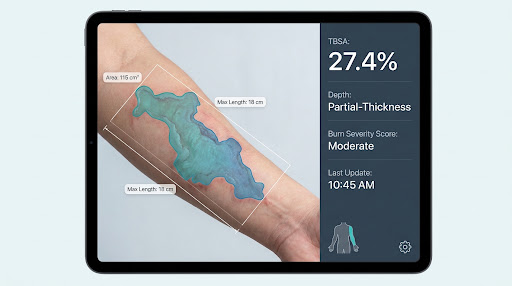
Photograph the burn. Doctor Burn measures the area, reads the depth region by region, and works out the fluid volume, so the number you act on comes from the wound, not from a wall chart and a judgement call.
Illustrative example, not a clinical trial result.
Total body surface area is judged by eye against a wall chart, then multiplied straight into the Parkland formula. Whatever error the estimate carries, the fluid plan inherits.
The same burn assessed by two clinicians, or on a different shift, does not reliably give the same percentage.
A newborn’s head is about 19% of body surface; an adult’s is 9%. Use the Rule of Nines on a child and the burn reads too small.
TBSA is a direct multiplier in the Parkland formula. An area that reads low gives a fluid volume that reads low with it.
How it works
[01]
Take the photo at the bedside on a phone or tablet. No extra hardware.
[02]
The wound edge is outlined automatically and its area measured.
[03]
Each area of the wound is assessed for depth.
[04]
A Parkland volume comes back with every assumption on screen, for you to check.
What it does
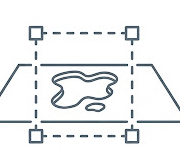
The burn edge is drawn from the photograph, so TBSA is measured rather than judged by eye, and the same photo gives the same number whoever holds the camera.
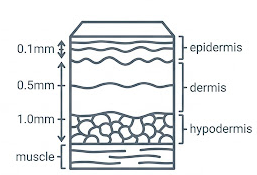
Superficial, partial and full thickness are told apart area by area, so burns that need a surgical opinion surface early.
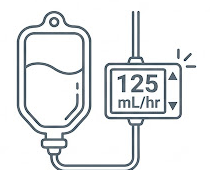
Measured area, weight and, for children, height give a fluid volume split across the first 24 hours, with every input visible.
TBSA methodology
A newborn’s head is about 19% of their body surface; an adult’s is 9%. Doctor Burn checks the age first, then uses the matching row of the Lund-Browder chart. It moves with the patient from birth to adulthood, where the Rule of Nines stays fixed.
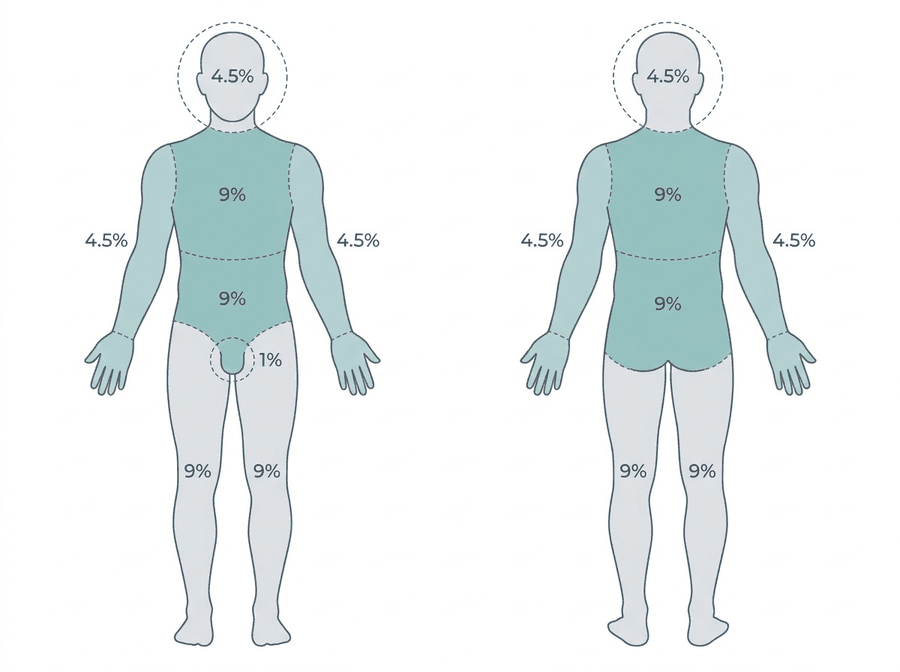
Nine percent blocks. Quick at the bedside, but the proportions never change with age.
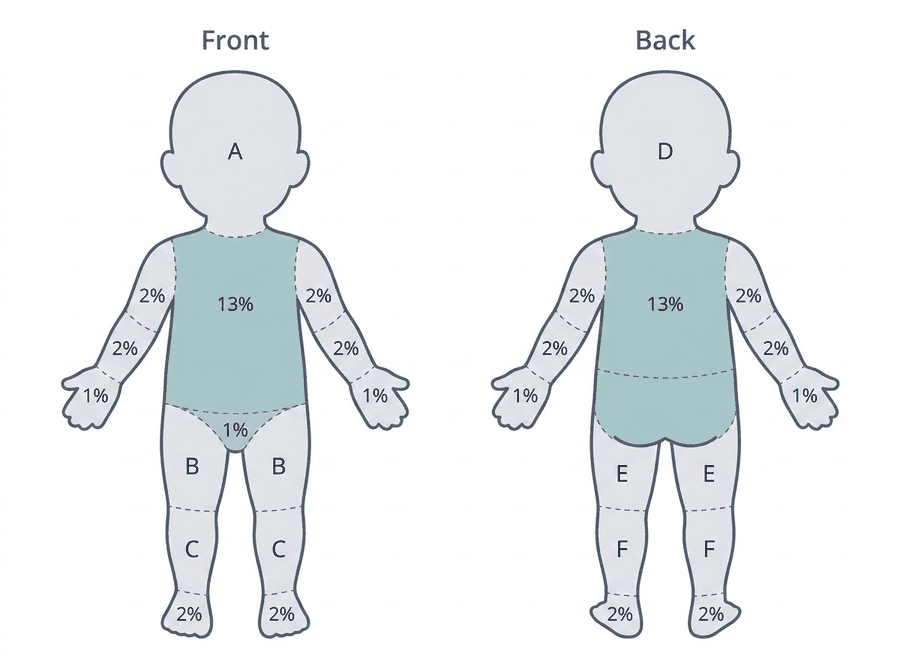
Head, thigh and leg change most while a child grows, so those come off the age table, up to an adult row.
| Area | 0 | 1 | 5 | 10 |
|---|---|---|---|---|
| Head (A/D) | 9.5% | 8.5% | 6.5% | 5.5% |
| Thigh (B/E) | 2.75% | 3.25% | 4% | 4.25% |
| Leg (C/F) | 2.5% | 2.5% | 2.75% | 3% |
The difference
Validation
Pilot partners receive the complete validation write-up, including where performance is strongest and where it is not.
A pilot runs alongside your existing workflow, so your team can compare results against their own assessments.
The assessment is built to be cautious about burns that need escalation, the cases that change management.
Worked example
Parkland formula for adults: 4 mL × weight in kg × %TBSA, half of it in the first eight hours. Children under 14 use the Galveston formula instead.
| Parameter | Value |
|---|---|
| Patient weight | 85.0 kg |
| Measured TBSA | 27.4% |
| Total fluid (24 h) | 9,316 mL |
Infusion timeline
Pilot programme
We work with burns units and emergency departments to run Doctor Burn against real assessments. A pilot runs alongside your existing workflow and changes nothing about how you treat.
FAQ
No. It gives an estimate to check against the patient. Every treatment decision, fluids included, stays with the treating clinician.
Pilot partners get the full validation report and test it on their own cases.
They are stored against the patient on our hosted service. You can delete a photo, or a whole patient record, from your workspace at any time. Deleted records leave your workspace, and Doctor Burn keeps them in its archive.
A phone or tablet camera and a browser. Nothing to install.
Trained healthcare professionals in emergency departments, burns units and retrieval teams. Not for patients or unsupervised use.
Explore Doctor Burn with our team. Tell us a little about your organisation and what you would like to see.
Get in touch